AI and search engine optimization in 2026: what carried over from SEO, and what we measured
Nine pages rank for this question on Google, and not one of them puts a number on whether its own advice works. We read all nine on 3 September 2026: Google's own optimization guide, a 10,000-word explainer, a vendor glossary, an agency service page and five more. Between them they recommend a great deal. Between them they report no test, no sample and no result. You can check that yourself in about ten minutes.
So we did the other thing. We took five of the things the search engine optimization playbook already teaches — answer the questions searchers ask, build domain authority, rank well on Google, get your crawler permissions right, and score your draft against what already ranks — and ran each one as a hypothesis against the pages an assistant actually cited. The corpus is 33 keywords across three related industries, measured mostly on ChatGPT, and each measurement is one moment rather than a standing truth. It is small and early, we say so every time, and it grows with a weekly sweep. Four of the five came back null or backwards. Our harvest could not test the fifth at all, and the reason is worth having on its own. Two other things behaved differently. The scoreboard is below, including the row that measured against our own product, and every figure in it links to the page where we published it with its sample.
Is SEO dead now with AI?
Search engine optimization is not dead in Google's AI features, and Google's own documentation for site owners is the cheapest place to check that rather than the loudest. That page states there are "no additional requirements to appear in AI Overviews or AI Mode, nor other special optimizations necessary" (Google, AI features and your website). The eligibility rule underneath it is one sentence long and worth having exactly: to be shown as a supporting link in AI Overviews or AI Mode, a page must be indexed and eligible to be shown in Google Search with a snippet, and there are no additional technical requirements beyond that.
Nothing in those documented requirements asks for a new file, new markup or a new schema, which is the technical worry most readers arrive with. The same page keeps its own honesty in view: meeting every requirement does not mean the content will be crawled, indexed or served, because "indexing and serving isn't guaranteed." That is Google describing Google. It covers AI Overviews and AI Mode, not ChatGPT, Perplexity or Gemini, and most of what we measured happened on a different surface — which is why the rest of this article keeps the two apart rather than blending them into one number.
On the technical half our own reading matches the documentation: the work is largely traditional SEO done properly — the same crawlability, indexing and snippet eligibility that has been sold for a decade — and what genuinely differs is selection, not crawling. We set that out at more length in what an agency can honestly do about it. Nothing in that half needs a new budget line.
What do GEO, AEO and "AI visibility" actually mean?
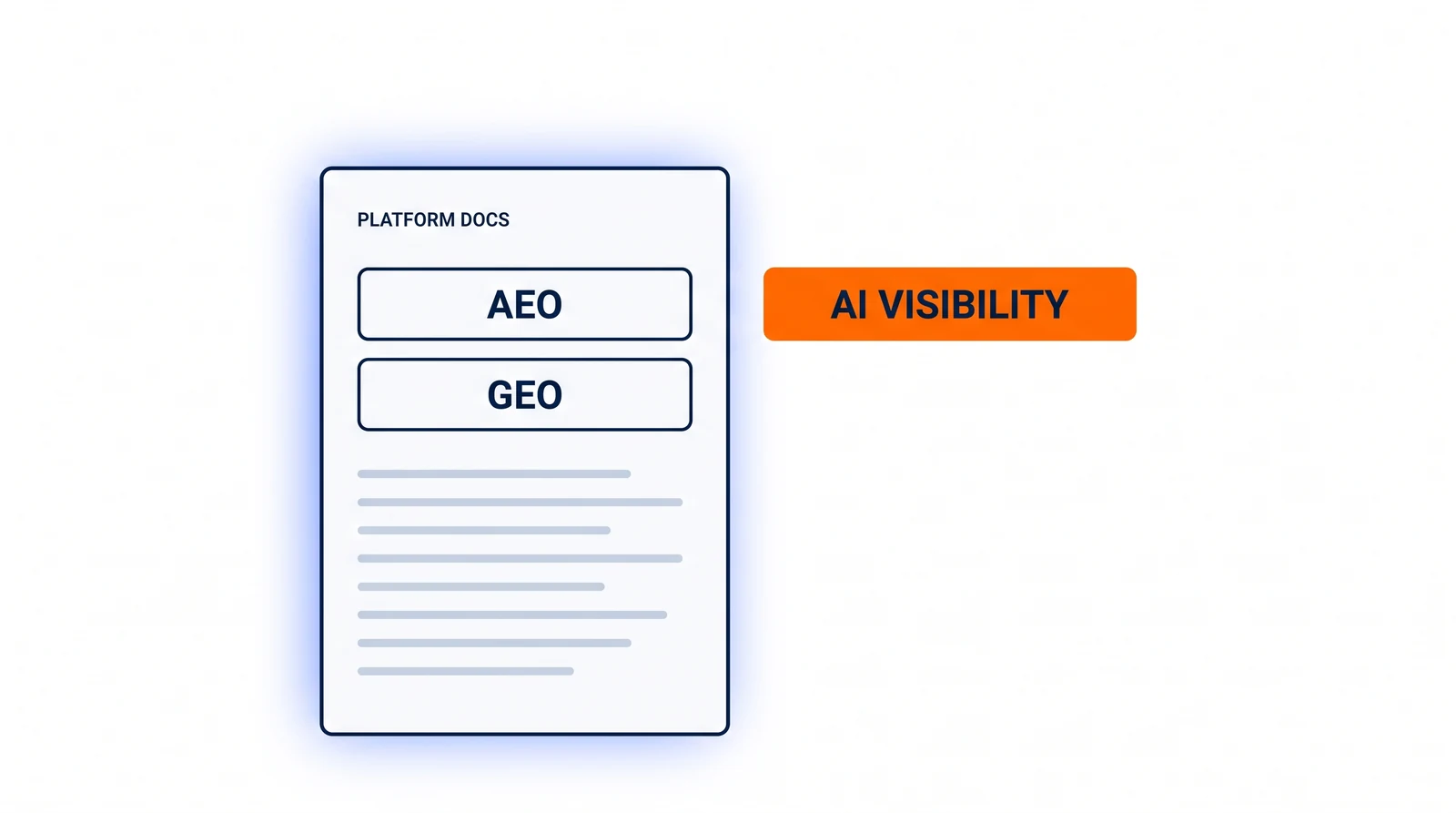
"AEO" is answer engine optimization and "GEO" is generative engine optimization, and the page ranking first for this query defines both in the same paragraph. Google's guide, last updated 10 July 2026, adds that both terms describe work aimed at visibility in AI search experiences, and then that "from Google Search's perspective, optimizing for generative AI search is optimizing for the search experience, and thus still SEO" (Google, optimizing your website for generative AI features).
Read that with its scope attached, because the scope is doing real work. Google is describing how its own generative features are built — on its core Search ranking and quality systems — and it is entitled to say that optimizing for them is still SEO. It is not describing the assistant surfaces where we took most of our measurements, and on those surfaces the ranking funnel and the citation funnel behaved very differently. Both statements are true at once because they answer different questions. Our fuller treatment of what Google says, including its list of tactics you can ignore, is in the tactics we tested and could not make work.
Two mechanism words are worth having from the same guide, because they come up in every vendor deck and are rarely defined. Retrieval-augmented generation, which Google says is "also known as grounding", is the technique of relying on its core Search ranking systems to retrieve relevant, up-to-date pages from its Search index before the answer is written. Query fan-out is a set of concurrent, related queries the model generates itself to fetch additional results — so one thing a person types can become several searches you never see.
"AI visibility" is the third word you will meet, and it is a category label rather than a platform one: it appears in neither of the two Google documents above nor in OpenAI's crawler documentation. Software vendors use it to mean some combination of being mentioned in an AI answer and being cited as a source in one. Those are two different measurements, and the distinction matters more than the acronym does.
What happened when we tested the SEO playbook against citations?
Four of the five search engine optimization playbook signals we tested came back null or backwards against the pages ChatGPT cited across a 33-keyword harvest, the fifth had too little variation in our sample to test at all, and two other things behaved differently. One scope line covers everything in this section. The comparison is cited pages against the pages that ranked for the same query and were ignored, three related industries, mostly ChatGPT, one moment per measurement.
Answering the questions searchers ask. This was our own hypothesis and we were confident about it. In our 33-keyword harvest we measured cited pages answering 58.8% of Google's People-Also-Ask questions and ignored pages answering 58.2%, which is a difference of nothing. We published both figures with the method behind them, on our research page. We kept the measure in our editor because it remains our strongest signal of article quality, and we stopped saying it buys citations — the longer version is in what a GEO tool can and cannot observe.
Building domain authority. We ran 21 matched pairs of pages competing on the same keyword, one from a higher-authority domain and one from a lower, and we measured the higher-authority page winning 11 and losing 10. Twenty-one pairs cannot rule out a small effect. They rule out a decisive one in that sample. The pairs and their limits are published with our methods, and the holders we keep finding fit the result, as our page on GEO companies sets out.
Ranking well on Google. In the same harvest we recorded 9 of the 73 pages ChatGPT cited also sitting in Google's top ten for the query that produced the citation — 12.3% of the citations we collected, with seven in eight coming from outside the first page of results. The overlap counts are pages rather than domains. We published those counts in our guide to user-friendly AI search optimization tools.
Getting your crawler permissions right. This is the row our harvest could not test, and saying so is more useful than a null. Whether a domain carried an AI-crawler block at all did not separate the cited domains from the ignored ones; blocks turned up on both sides at similar rates. We looked at 230 domains and found only 1 of them blocking OAI-SearchBot — one blocker in 230 is too little variation to weigh, so nothing in our harvest tells you whether blocking that crawler costs citations. OpenAI's own documentation says it does: it names OAI-SearchBot as the crawler that surfaces sites in ChatGPT's search features, states that sites opted out of it "will not be shown in ChatGPT search answers", and recommends allowing it in robots.txt to help a site appear at all. The conclusion that survives our measurement is narrower: across those 230 domains, the block most sites carry is not the block that decides citation. That measurement is not yet written up on our research page, so weigh it accordingly, and our strategies piece sets out what it does and does not show.
Scoring your draft against what already ranks. This is the uncomfortable one and it is ours. We ran our own fitted content score against blind judgements from independent reviewers who saw no scores at all, and we measured it running negative. A meter fitted to the consensus of the pages already ranking was, in that trial, pointing away from the writing the reviewer preferred. The coefficients, the sample sizes and the confounds are in the section on scoring below, and the trial is written up in full.
Two things behaved differently from those five, and only one of them was a test.
How the question is framed. In a ladder we wrote down before we ran it, five topics were each phrased four ways — conceptual, entity-state, dated, and a recommendation with a jurisdiction attached. None of the five conceptual framings drew a citation from anyone. All five dated framings did, and so did all five recommendation framings. We measured mean pages cited moving from 0.0 at the conceptual end of the ladder to 6.4 at the dated one. The per-topic counts are published with that test. Five topics on one engine primarily is a small test. The direction was unambiguous; the exact rates are not portable.
The unit of citation. Some assistant citations point at a single highlighted sentence inside a page rather than at the page, and we recorded one article in our harvest cited four times for four different passages. That reading is published with the rest of the harvest. Nothing about that page changed between the four selections; four different sentences in it answered four different things. That four-citation reading is an observation about granularity rather than a hypothesis we tested: we ran no treatment and control on how self-contained a sentence is, and our research page states the limit we work under — we observe what cited pages share, and cannot yet prove that adding those properties causes citation.
How is AI changing SEO in 2026?
The change AI made to search engine optimization by 2026 is that ranking well and being quoted are now two separate selections: across a 33-keyword harvest we recorded 276 ranking pages, and only 9 of them were also pages ChatGPT cited for the same queries. Both counts are on our research page. Those 9 pages are an overlap between two sets, not a map of the machinery: we did not measure how an assistant reaches its sources, and OpenAI's documentation says only that ChatGPT "ranks search results using multiple factors" and that its search sometimes partners with other search providers. The old work still does what it always did. It no longer finishes the job.
The first of those two selections decides whether the assistant looks at the web at all. We measured nobody being cited on 12 of the 33 keywords in that harvest, at any quality level: no page won, because no search ran. We set that result out in our agency piece. The gate is a real, documented and tunable thing in the systems that publish their mechanics, and it belongs to the question rather than to your page. Nobody publishes a threshold for the consumer assistants, so nobody can honestly quote you one. The documentation that does exist comes with limits we state there.
The second is made at the level of the sentence rather than the page. A page assembled from the consensus of everything already ranking is, by that measurement, competing in the wrong set — which is a strange thing for a company that sells a content score to have found, and the next section is about that. For the shorter, practical version of the retrieval half, we wrote how to get citations from ChatGPT.
What does this change about how you score a draft?
We measured the 43 pages ChatGPT cited in our harvest at a median of 65 on our own citability checklist, with only about one in twenty of those 43 reaching 85 — so the pages an assistant actually cited are not the pages a content score calls excellent. We publish that on our research page. A very high reading on our own meter is not what a cited page looks like. Our score bands now treat 85 and above as informational rather than as a target, because the winners' zone in that sample sits well below it. We took apart what a visibility number counts, and what it is measured against, in a separate piece on visibility analytics.
The scoring row from the scoreboard belongs here too, with its scope. In a pre-registered trial, 15 articles were each read cold by an independent reviewer who saw no scores at all. We measured our fitted score at rho −0.61 across the 9 articles it covered, and −0.61 again across all 15. The benchmarked competitor meter did the same thing on its 6, at −0.63. We name that only beside our own number, and we do not name the company, because the finding is about scores fitted to what ranks — ours included, and ours first.
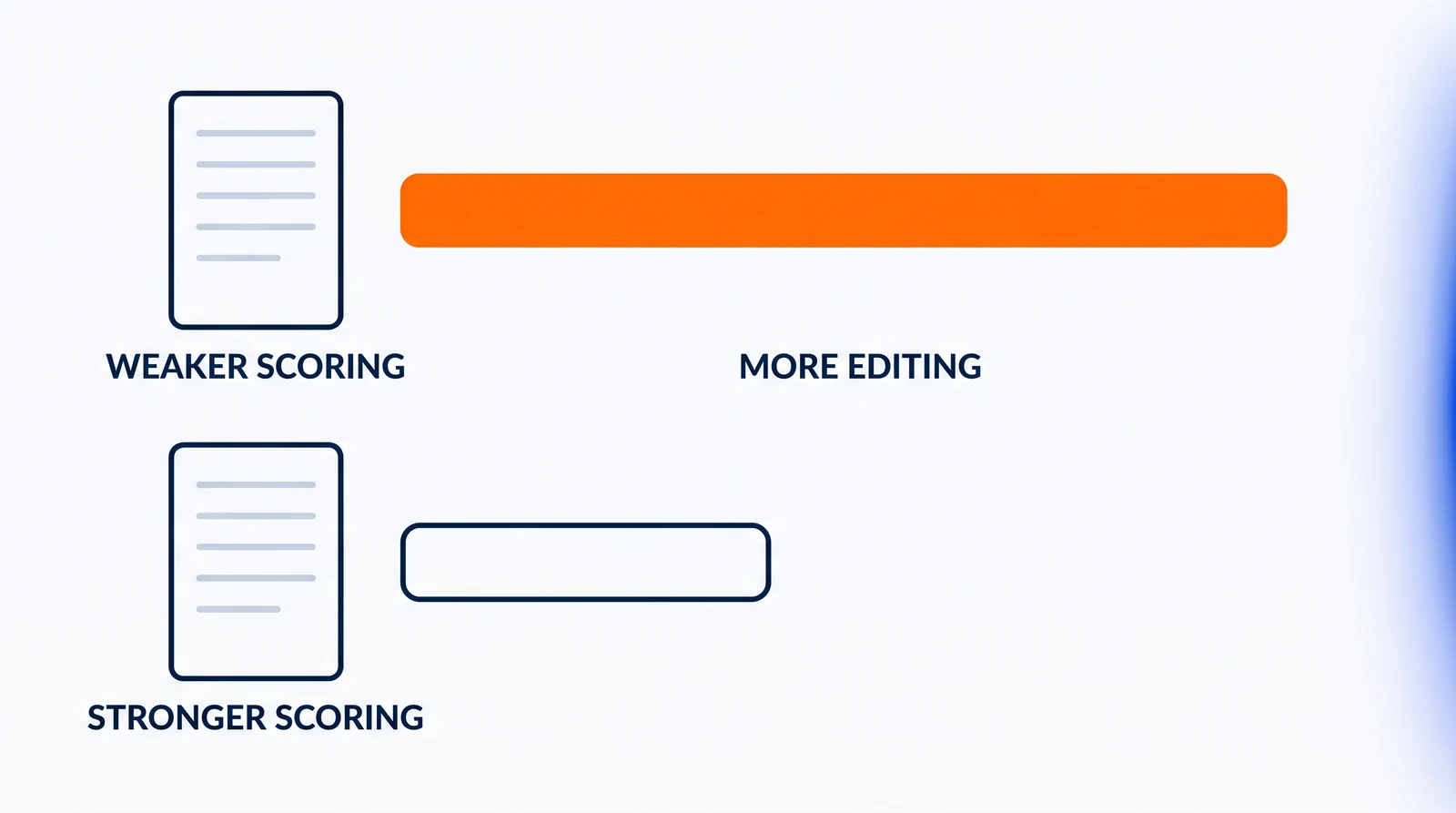
Three limits belong in the same breath. Every draft in the trial scored between 71 and 90. What failed was the meter's ability to rank good writing against itself, not its ability to tell bad writing from good. The cold reads were done by independent reviewer agents, one per article, on a seven-dimension scorecard. A human blind read of the same set is prepared and not yet done. One confound could produce the result on its own, and we log it on our research page rather than bury it: our editing loop revised each draft until the score cleared 75, so the weaker-scoring drafts received more editorial work than the strong ones. That is why we read the trial as a reason to stop selling a score as a quality grade, and not as a measured law that scores run backwards.
We build one of these meters, so read the next sentence as our view of what matters rather than a neutral standard. A content score is useful as a coverage check — what a draft is missing that the field genuinely discusses — and unreliable as a quality grade. That is how ours is now built and described. If a vendor sells you a score as a grade, the question worth asking is whether they have run this measurement on it and published the answer.
How would you know whether any of it is working for you?
The Generative AI performance report in Search Console is free, it is your own first-party data, and it covers AI Overviews and AI Mode only. Google's guidance names it directly, telling site owners to use that report to measure how content performs in generative AI features on Search and Discover (Google, optimizing your website for generative AI features). Its narrowness is exactly the gap third-party monitoring exists to fill for every other surface.
Our read, and we mark it as a read rather than a measurement, is that an impressions console cannot tell you whether an AI answer cited you. Steady positions with falling clicks is a different measurement, not a harder version of a ranking problem, and we built our product on measuring citations off the answer surfaces instead of inferring them. We think, on the same basis, that the unit of value is a citation rather than a crawl. How often a page is fetched and how often it is used are separate quantities, and only the second one pays.
One infrastructure company reached a strikingly similar reading, and it is worth reporting as theirs rather than as evidence for ours. On 1 July 2026 Cloudflare described starting to reshape its pay-per-crawl product into a pay-per-use one, in experiments with named partners, on the grounds that "crawling is a crude measure of value. A single page might be crawled once and then cited in thousands of answers, or crawled over and over and never used at all." Of the partner model it describes, it writes that "payment is designed to follow the value the work delivers rather than the number of times a crawler happens to fetch it." That is one company's product direction, announced by that company and still at the experiment stage. It neither confirms nor tests anything we measured.
Before paying anyone, the first thing worth knowing is whether an assistant searches for your topics at all. We read 58 topics in one commercial category on 10 August 2026 and found no domain cited at all on 14 of them — one category, one day, mostly ChatGPT. The full reading is in what ChatGPT cites in 2026. The second thing worth knowing is that the slot is not reserved for companies selling into your category. We checked one query on 3 August 2026 and the three sites holding the citations were a preprint server, an SEO and AI-visibility agency, and a custom-CRM software company whose own website says nothing about generative engine optimization at all. We reported that with the rest of that check.
If you want to run something yourself this week rather than buy a dashboard, four free checks need nothing but a browser and half an hour.
What people actually ask
Google shows four questions alongside searches about AI and search engine optimization, and each one is answered below in a single self-contained paragraph so a person or an assistant can take any of them whole.
What is the 30% rule for AI? It is not a search or citation rule, and the phrase does not appear in the four pieces of platform documentation this article draws on: Google's optimization guide for generative AI features, Google's page on AI features and your website, OpenAI's crawler documentation and OpenAI's own page on ChatGPT search. All four are linked below and searchable in a minute. What circulates under the name is a workflow heuristic about how much of a job to hand to a model, and different writers define it in opposite directions — some putting the human share at 30%, some the model's. Whichever version you meet, it describes how a team divides its work, not how an assistant decides what to quote.
Can ChatGPT help with SEO? Yes, as a research and drafting assistant — which is a different question from the one this article measures, because we measure which pages assistants cite, not which tool wrote the page.
Is AI search optimization different from traditional SEO? On Google's own surfaces, its documentation says the SEO best practices still apply and no additional requirements exist. On the assistant surface we measured most, the selection step behaved differently, and the pages that ranked and the pages that got quoted barely overlapped in our harvest — the counts are in the section above. Both answers are true because they answer different questions. One is about how a set of features is built; the other is about which pages a different assistant chose. Our section-by-section version of that comparison has the tests behind it.
Where should someone start who has never measured any of this? Start with the free first-party report above, because it costs nothing and it is your own data, then pick five real questions your buyers ask and run them through one assistant yourself, recording what it cites. That is a small sample and it will not settle anything — ours is small too — but it will tell you within an afternoon whether an assistant searches for your topics at all, which is the first thing worth knowing and the thing no dashboard can decide for you.
Sources
- Google — Optimizing your website for generative AI features on Google Search — the AEO/GEO definitions, "thus still SEO", retrieval-augmented generation and query fan-out, and the Generative AI performance report. Last updated 10 July 2026; checked 4 September 2026.
- Google — AI features and your website — no additional requirements for AI Overviews or AI Mode; indexing and snippet eligibility; "indexing and serving isn't guaranteed". Last updated 10 December 2025; checked 4 September 2026.
- OpenAI — Bots and crawlers — GPTBot as the training crawler, OAI-SearchBot as the search one, the two settings being independent, and OpenAI's recommendation to allow OAI-SearchBot. Checked 4 September 2026.
- OpenAI — ChatGPT Search — ChatGPT ranks search results using multiple factors and placement is not guaranteed; its search sometimes partners with other search providers; allowing OAI-SearchBot is what makes a site eligible for inclusion. Checked 4 September 2026.
- Cloudflare — Making AI search smarter — paying publishers when their work is used in an answer rather than per crawl. Published 1 July 2026; checked 4 September 2026.
- LiamVi — Research: our methods, samples and limits — the 33-keyword harvest, the People-Also-Ask null, the 21 matched pairs, the framing ladder, the passage evidence, the blind-judged calibration with its logged confound, and where cited pages score. Last updated 12 August 2026; checked 4 September 2026.
- LiamVi — AI search optimization agencies in 2026 — the carried-over technical half, the retrieval gate and its documentation limits, and the 12-of-33 result.
- LiamVi — Generative engine optimization strategies for AI visibility — the framing ladder's counts, the passage evidence, the crawler measurement and Google's mythbusting list.
- LiamVi — AI visibility analytics for search optimization — what a visibility number counts, and where cited pages score on our checklist.
- LiamVi — AI tools with the best generative engine optimization features — what a tool can observe, sample and only infer, and the People-Also-Ask null in full.
- LiamVi — What does ChatGPT cite in 2026 — who held the citations in one measured category, and how to read any citation index.
- LiamVi — Top user-friendly AI search optimization tools — the ranking-versus-citation overlap, and four free checks.
- LiamVi — Generative engine optimization companies — the matched-pairs result and who actually held the citations for one query.
- LiamVi — How to get citations from ChatGPT — the crawler distinction, and the queries that drew a citation for nobody.